
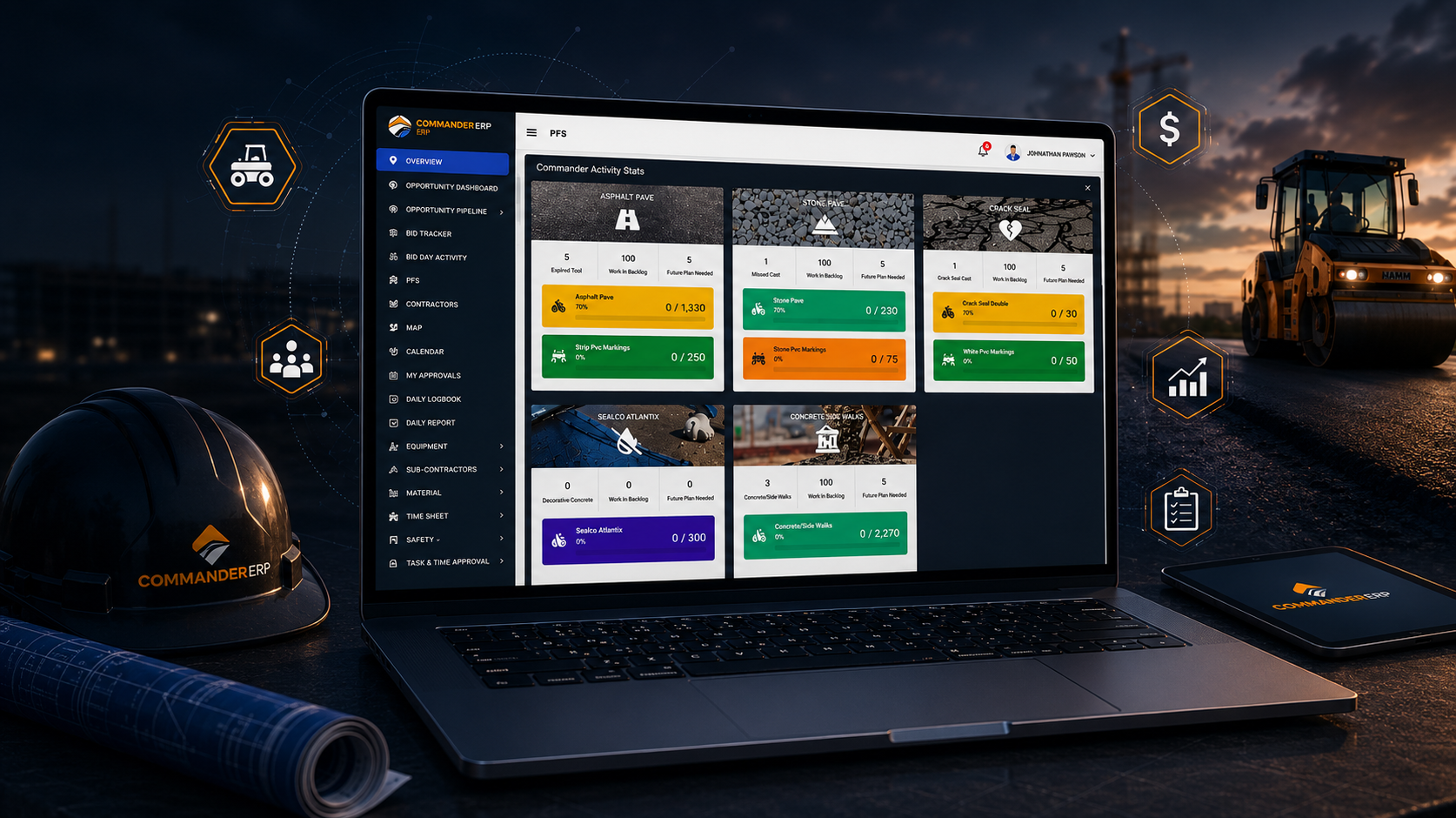
From Eight Disconnected Tools to One ERP for Paving Contractors
Commander ERP's founders were running a multi-state paving business on nearly eight separate software products. Overseas IT Solution helped turn that operating experience into a multi-tenant cloud platform that connects the lead, the bid, the job and the truck in one place.
Project Overview: A Paving Business, Rebuilt as Software
Commander ERP is a cloud platform for companies that pave, seal, crack-seal, stripe and pour concrete. It was conceived by a fourth-generation paving family who knew first-hand what it costs to run a field-heavy business across spreadsheets and single-purpose apps.
The aim was not another generic CRM. It was an operating system for a paving company: software that understands proposals, tonnage, manhours, trucks and sealer gallons, and that other contractors could subscribe to.
Leads, estimates, job costs, crew hours and fleet records lived in different systems, so no one could see whether a job was making money until it was finished.
A purpose-built ERP that follows every job from first contact to final cost and measures production in the units paving crews actually use.
Watch Commander ERP in Action
See how Commander ERP unifies the entire paving contractor operation — from lead qualification and precision tonnage estimating to live crew dispatch, fleet maintenance logs, and job profitability tracking.
The Business Challenge: Paving Companies Lose Margin in the Hand-offs
A paving job passes through many hands. A salesperson logs a lead. An estimator reviews the property and decides whether to bid. A proposal goes out. If it is won, crews, trucks, materials and equipment are scheduled, and fuel, labor and maintenance costs build up in the field.
When each step lives in a different tool, three things go wrong.
Leads go cold without anyone noticing.
Follow-ups sit in personal calendars, and there is no single list of opportunities that were never priced.
Job profitability arrives too late.
Material tickets, crew hours, trucking and fuel are reconciled after the job, when it is too late to rescue a job that is drifting over budget.
Production is measured in the wrong units.
Generic software counts tasks and hours. A paving owner needs tons laid per manhour, sealer gallons per manhour and crack-seal blocks per manhour, measured against monthly and yearly targets.
The founders lived this. Running their own company on nearly eight separate products meant duplicate data entry, conflicting numbers and decisions made on yesterday's information. Off-the-shelf construction suites were built for general contractors and large civil firms, not for the pace and unit economics of paving and maintenance work.
"If you can't see a job's cost while the crew is still on site, you can only learn from the loss."
Project Goals
| Goal | Problem it answers |
|---|---|
| One record from lead to final cost | Data re-typed between CRM, estimating and job tracking tools |
| Make neglected work impossible to miss | Overdue follow-ups and opportunities that never became bids |
| Show job cost by category while work is underway | Profitability discovered only after the job closes |
| Measure production in paving units | Generic metrics that do not reflect crew productivity |
| Keep trucks and equipment accountable | Fuel, maintenance and inspections tracked on paper or in separate apps |
| Make it sellable to other contractors | A single-company tool needed tenant isolation, self-service sign-up and subscription billing to become a product |
The Solution: One Pipeline, From First Call to Final Cost
Overseas IT Solution designed Commander ERP around the way a paving company actually makes money: win the right jobs, then deliver them at the planned cost. Every module feeds the next, so information is entered once and reused.
Capture: Client and Lead
A client and lead are recorded in the CRM with their source, assigned rep and next follow-up.
Qualify: Opportunity Review
Each opportunity gets a code, an estimator and a decision: Reviewed & Bid or Reviewed & No Bid.
Price: Bid & Proposal
Bids carry the proposal price and status and can be exported as PDF.
Deliver: Active Job Execution
Won work becomes a project that tracks material, labor, trucking, equipment and fuel costs.
Learn: Production Goals & Analytics
Goals and reports show production per manhour, win rates and which lead sources pay off.
Key Features and Capabilities
Opportunity and bid insights
A live summary sits above every pipeline list: total opportunities, bid conversion rate, overdue items, the top estimator, the top client and the number of opportunities still waiting for a bid. Review statuses and due dates drive the counts, and managers can filter by week, month, year or all time. The result: leads stop expiring quietly, and managers can see where revenue is leaking from the pipeline and act the same day.
Project consumption dashboard
For any project and date range, the platform totals cost by material, labor, trucking, equipment, fuel and maintenance, general bid items and other items, with each category's share of the total and a labor breakdown in dollars and hours. Owners see which cost category is driving a job while there is still time to respond, instead of finding out after the job closes.
Production goals in paving units
Monthly and yearly goals cover each product line, including asphalt tons, stone tons, crack-seal blocks, sealer gallons and concrete cubic yards, each paired with a productivity ratio such as tons per manhour. Progress bars show actual results against target, giving crews and managers a shared, objective scoreboard in the units that drive margin.
Sales and lead-source analytics
Charts compare proposal count, proposal amount and win amount by month and year across multiple years, break opportunities down by lead source and show performance by salesperson. Every chart exports to PDF or Excel. Leaders can see which channels and people bring in work worth winning, and plan staffing and marketing spend accordingly.
CRM built around follow-up discipline
Client records hold type, location, revenue, services performed, contact frequency and the products each client buys. Filters by assigned rep, next follow-up date and product make building a call list quick, and overdue follow-ups are counted at the top of the screen. Repeat and referral work, the most profitable kind for maintenance contractors, finally gets a dependable process.
Fleet, equipment and back-office records
Dedicated logs for truck and equipment fuel, maintenance and inspections sit alongside time tracking, payroll reports, supplier and product catalogs, and an internal news bulletin for crew communications. Records that used to live in separate apps or on paper now share one system and one login.
A SaaS foundation: tenants, plans and billing
Contractors can sign up, start a free trial and choose a plan without a sales call. Each company works in its own tenant with its own administrator, and subscription billing handles renewals and expiry automatically. This is what turned an internal tool into a product the client can sell, with tiers that scale from a small crew to a large operation.
Tenant Isolation
Private workspace & database scoping for every contractor on high-efficiency shared infrastructure.
Self-Service Plans
Public pricing, clear tiers, automated free trials, and upgrade workflows without requiring sales calls.
Stripe Billing
Automated recurring subscriptions, renewals, card handling, plan proration, and graceful expiry.
Technology Stack and Architecture
In plain terms:
Commander ERP is a single web application used by many companies at once, each seeing only its own data. Business logic is kept separate from screens and from data storage, so new modules and reports can be added without disturbing the ones customers already rely on. Payments run through a dedicated billing provider rather than custom card handling.
For technical readers:
The platform is written in C# on ASP.NET Core (.NET 8) with Entity Framework Core and a PostgreSQL database, organised as a layered solution: a Web project for the server-rendered interface, a Core project for domain entities and rules, an Infrastructure project for data access, a Services layer for business workflows, and an API project. Tenant context scopes data to each subscribing company. Stripe manages subscriptions, while hosted background services handle renewals, expiry and templated email notifications. SignalR supports real-time communication, Serilog provides structured logging, and dashboards use interactive charts and data tables with CSV, Excel, PDF and print export.
Implementation Approach
Learning the trade.
The requirements came from people who run paving crews. Terms like crack-seal blocks, sealer gallons and tons per manhour went straight into the data model and dashboards instead of being forced into generic fields.
Designing for many companies.
Because the product was meant to be sold, tenant separation, roles and plan limits were built into the architecture from the start rather than added later.
Building one connected pipeline.
Clients, opportunities, bids and projects were designed as a single chain, so the reporting at the end of the chain can be trusted.
Automating the subscription lifecycle.
Trials, subscriptions, renewals and expiry run through the billing provider and scheduled jobs, with templated emails that keep customers informed.
Refining the interface.
As modules grew, the interface moved to a consistent design system with light and dark themes, shared insight cards and standard table tools, so every screen behaves the same way.
Challenges and how we handled them
One codebase, many companies.
Every contractor's data must stay private. Our team used tenant-scoped data and a tenant administrator role. The trade-off is discipline: every new query and report has to respect tenant context.
Breadth without clutter.
The product spans sales, operations, fleet and payroll. Grouped navigation and the same insight-card and table pattern on every list keep it learnable, and role-based views are a natural next step as it grows.
Metrics owners can trust.
Productivity ratios are only useful if their inputs are consistent, so they are derived from the same consumption and labor records used for job cost. Goals depend on timely data entry, which is why a month with no entries shows as zero rather than an estimate.
From internal tool to business.
Self-service registration, plan tiers and an automated subscription lifecycle turned a company system into a product. Plan limits and billing states have to be handled consistently throughout the application.
Business Value and Expected Impact
Commander ERP is commercially available as a subscription product, with a free trial, published plans and self-service sign-up. The platform is designed to deliver these benefits for contractors who adopt it:
Fewer tools to buy, learn and reconcile
Because CRM, bidding, job cost, fleet logs and reporting share one system.
Fewer lost opportunities
Because every lead gets a review status, an owner and a due date, and overdue work is counted on screen.
Earlier warning on job cost
Because consumption is visible by category while a project is running.
Clearer crew productivity
Because goals are tracked in tons, gallons and cubic yards per manhour.
Sharper sales and marketing focus
Because win amounts can be compared by month, year, salesperson and lead source.
Who it is for, and where it can go next
Supported Today
Asphalt paving and patching contractors, sealcoating and crack-sealing companies, line striping and concrete contractors, and multi-crew operators running their own trucks and equipment.
The same approach can serve
Landscaping and snow removal companies, roofing, excavation and site-work contractors, field-service businesses that bid work, schedule crews and track materials, and any niche trade that wants to turn its know-how into a SaaS product.
Future Opportunities
Conclusion
Commander ERP started with a familiar problem: a growing contractor running on too many tools, with job profitability arriving too late. The answer was a single platform that follows each job from first call to final cost and measures performance in the units crews actually use. Built as multi-tenant SaaS, it also became a product the founders can offer to other contractors.
If your business has the same pattern, with deep industry knowledge trapped in spreadsheets and disconnected apps, a purpose-built system can turn that knowledge into an operating advantage, and possibly into a product of its own.
Have a Workflow That Off-the-Shelf Software Doesn't Fit?
Tell Overseas IT Solution how your business runs today. We'll review your workflow, show you where time and data are being lost, and outline what a custom platform or SaaS product could look like for you, with no obligation.